V-Pulls & L-Turns
Two ball-mastery moves on one square of floor: the V-pull that drags the ball back and pushes it out, and the L-turn that drags it behind the standing leg.
Hear the coach on this drill
Every line the Audio Coach says in this drill, played back to back; the time beside each is when it comes in the 10-minute drill. No account needed.
Set-up
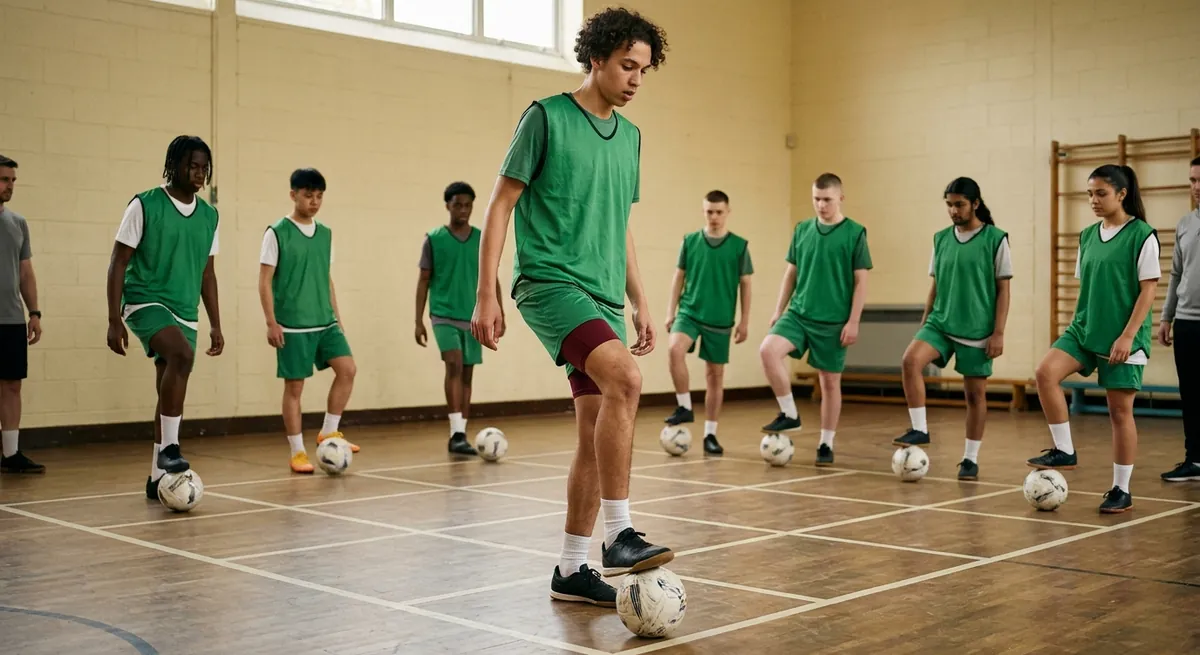
A square of floor about two strides a side, hard floor or thin carpet so the ball rolls, one ball sitting in the middle and shoes with grip. The parent stands facing the player, close enough to see the sole land on the ball and to count the sets out loud.
What you need
- 1 soccer ball
The ground: 8 × 8 ft (about 2 × 2 m). One child can run it alone in a backyard. The space and equipment check lists every drill that fits the ground you have.
How to run it
- Set up. A square of floor two strides a side. One ball, sitting in the middle. Shoes with grip.
- V-pull. Sole on top, drag the ball back towards you, then push it out at an angle with the inside of the same foot. Back and out makes a V. Ten each foot.
- L-turn. Sole on top, drag the ball back and across behind the standing leg, then step round and carry it away. Ten each foot.
- Link them. V-pull, V-pull, L-turn, and walk the ball back to the middle. Five times each way.
- Speed. Thirty seconds of V-pulls as fast as the sole still lands on top. Then thirty of L-turns.
- Count it. One minute of V-pulls alternating feet. Write the number down.
Coaching points
- The sole lands on top of the ball first; the toe never pokes it
- Knees soft and body over the ball, so the drag is a drag and not a kick
- Each move ends where it began: the ball does not drift across the room
What to watch: The toe poking the ball instead of the sole dragging it, and the ball drifting across the room. Each move ends where it started.
Common mistakes
- The toe poking the ball instead of the sole dragging it
- The ball drifting across the room because each move does not end where it began
- Standing upright over the ball so the drag becomes a kick
- Only ever leading with the stronger foot
- Speeding up before the sole lands on top every time
What good looks like
A good target: 40 V-pulls in 60 seconds alternating feet, the sole on top every time.
Progressions and variations
Making it harder
- Level 1: Each move at a walk, stopping the ball dead between them
- Level 2: Ten of each with each foot, no stop between
- Level 3: The moves linked in a pattern
- Level 4: A sibling or parent calls V or L and the foot
- Level 5: The counted minute, alternating feet
- Level 6: Eyes up on a fixed point for the whole minute
Alone, with a sibling, or in a group
- Solo: three times through on a phone timer, counting each set of ten out loud.
- Sibling: facing each other two strides apart, mirroring moves, the leader swapping each set.
- Co-op: a grid of squares with one leader calling V or L and which foot.
Adjusting it by age
- U14: One move at a time with a dead stop between, the sole landing on top every time before any speed. Count the sets together.
- U18: Link the moves at speed with the eyes up, both feet equally, and follow with the figure-eight or the shadow 1v1 so the moves are used going somewhere.
For the parent running it
- Count the moves out loud in sets of ten and watch the sole. Both moves start with the sole on top of the ball, never the toe poking it.
Safety
- A hard floor or thin carpet; thick carpet grabs the sole and twists the ankle
- Nothing breakable within a ball's roll of the square
More on training safely at home: Safety at Home.
Related drills
Toe Taps & Sole Rolls
Alternate tapping the top of the ball with each foot (toe taps), then roll the ball forward/back with the sole.
Juggling Challenge
Keep the ball in the air using feet, thighs, and head. Count consecutive touches.
Sole Roll Turns
Move the ball with the sole only, rolling it across the body and dragging it back to turn, the way futsal players keep it close on a hard floor.
Pull-Push
Pull the ball back with the sole and push it forward with the laces of the same foot, in a rhythm, then away at an angle: futsal's most basic way to keep the ball moving under a defender.
Run it with the Audio Coach
In Spatrian the Audio Coach talks your player through this drill while they play it, and each run goes on their own training record, which their coach or personal trainer can read and, for a homeschool family, counts as PE time. The beta is opening to a small first group of players and families.