Pivô Hold-Up and Lay-Off
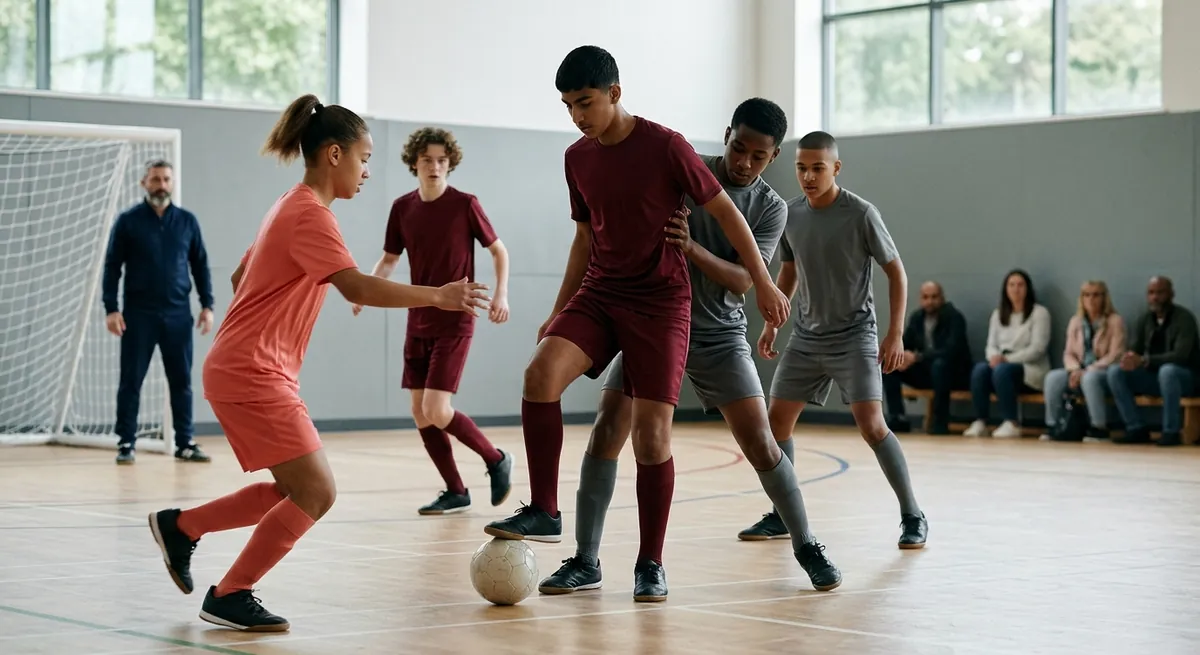
Receive with your back to goal like a futsal pivô, stop the ball under the sole while shielding it, and lay it off first time to a runner arriving from behind.
Hear the coach on this drill
Every line the Audio Coach says in this drill, played back to back; the time beside each is when it comes in the 12-minute drill. No account needed.
Set-up
Two cones about eight steps apart on a hard floor or a patch of grass. The child stands at one as the pivot with their back to the other, where the parent starts with the ball. For solo work, a flat wall replaces the parent and the passes come back off it.
What you need
- 1 futsal ball or soccer ball
- 2 cones
- A flat wall for solo work
The ground: 30 × 15 ft (about 9 × 5 m). One child can run it alone in a backyard. The space and equipment check lists every drill that fits the ground you have.
How to run it
- Set up. A cone where the child stands as the pivô, and a second cone about eight steps away where the parent starts with the ball.
- Ball in. The parent plays the ball firmly along the floor into the child's feet.
- Hold. The child receives back to the parent, stops it under the sole and shields it with the body, arms out for balance.
- Run past. As the ball is held, the parent runs past to one side, calling 'here'.
- Lay off. The child rolls the ball off the sole into the parent's path, first time, with the inside of the foot.
- Count it. Ten lay-offs to each side, counting the ones that reach the runner without breaking stride.
Coaching points
- Hold before you lay off: the sole stops the ball and the body shields it
- The lay-off goes into the runner's path, a step ahead of them
- Glance over the shoulder before the ball arrives to see where the runner is
What to watch: Turning too early. The pivô holds first: the sole stops the ball and the body stays between the ball and the imaginary defender before the lay-off.
Common mistakes
- Turning straight away instead of holding the ball
- Standing upright, so the body cannot shield the ball
- Laying the ball to where the runner is rather than a step ahead
- Not glancing over the shoulder before the ball arrives
- Letting the ball bounce off the sole instead of stopping it
What good looks like
A good target: 8 of 10 lay-offs to each side reach the runner without them breaking stride.
Progressions and variations
Making it harder
- Level 1: The wall version, hold for two and pass back
- Level 2: With a parent, a soft pass in and a walking run
- Level 3: A firm pass and a jogging run
- Level 4: Eight of ten lay-offs reaching the runner in stride
- Level 5: A passive defender behind who may touch but not tackle
- Level 6: The runner chooses the side late and the pivot reads it
Alone, with a sibling, or in a group
- Solo: the wall version, counting clean holds and angled returns in a minute.
- Sibling: one plays in and runs, the other holds and lays off, then swap.
- Co-op: add a defender behind the pivô who may touch but not tackle.
Adjusting it by age
- U14: Start with the wall and a still hold of two seconds before any runner joins in.
- U18: Add a defender leaning on the back and a choice for the pivot: lay it off, or turn when the defender over-commits.
For the parent running it
- The parent stands about eight steps away and plays the ball in along the floor, then runs past to one side. The child receives back to the parent's goal, holds it under the sole, and lays it off into the parent's run.
On their own: Alone, use a wall: pass in, receive the return with the back half-turned, hold it under the sole for a count of two, then pass back into the wall at an angle.
Safety
- A defender may lean but never push or tackle from behind
- Shin guards once a defender is added
More on training safely at home: Safety at Home.
Why it matters
The pivô is the team's reference point up front: every hold-up and lay-off gives teammates time to arrive, and the same skill makes a striker useful outdoors.
Related drills
Half-Turn Diamond
Check away, receive side-on with the back foot, and play forward on the second touch.
Wall First Touch
Pass into a wall and kill the returning ball dead with one touch, then play it back with the next.
Sole Stop and Wall Pass
Pass against a wall and stop the return dead under the sole, then pass again: the first touch a futsal player uses on every ball that comes to them on a hard floor.
Receive, Half-Turn, Pass
Play the wall, open the body as the ball comes back, take the first touch across the body through a gate and pass again: the midfielder's half-turn off a wall.
Run it with the Audio Coach
In Spatrian the Audio Coach talks your player through this drill while they play it, and each run goes on their own training record, which their coach or personal trainer can read and, for a homeschool family, counts as PE time. The beta is opening to a small first group of players and families.