GK Hands: Low Catches
Handling with no dive and no ceiling needed: catches seated, kneeling and in a crouch, the W-shaped hands and the scoop a keeper's whole game rests on.
Hear the coach on this drill
Every line the Audio Coach says in this drill, played back to back; the time beside each is when it comes in the 10-minute drill. No account needed.
Set-up
A clear square of floor with the keeper seated, legs out, and the parent three steps away with one ball and nothing breakable behind the keeper for a serve that is dropped. A mat or carpet is kinder on the knees for the kneeling set. No ceiling height is needed; nothing goes above the chest.
What you need
- 1 soccer ball
The ground: 10 × 10 ft (about 3 × 3 m). One child can run it alone in a backyard. The space and equipment check lists every drill that fits the ground you have.
How to run it
- Set up. A clear square of floor, one ball, and the keeper seated with legs out. You three steps away. Nothing breakable behind them.
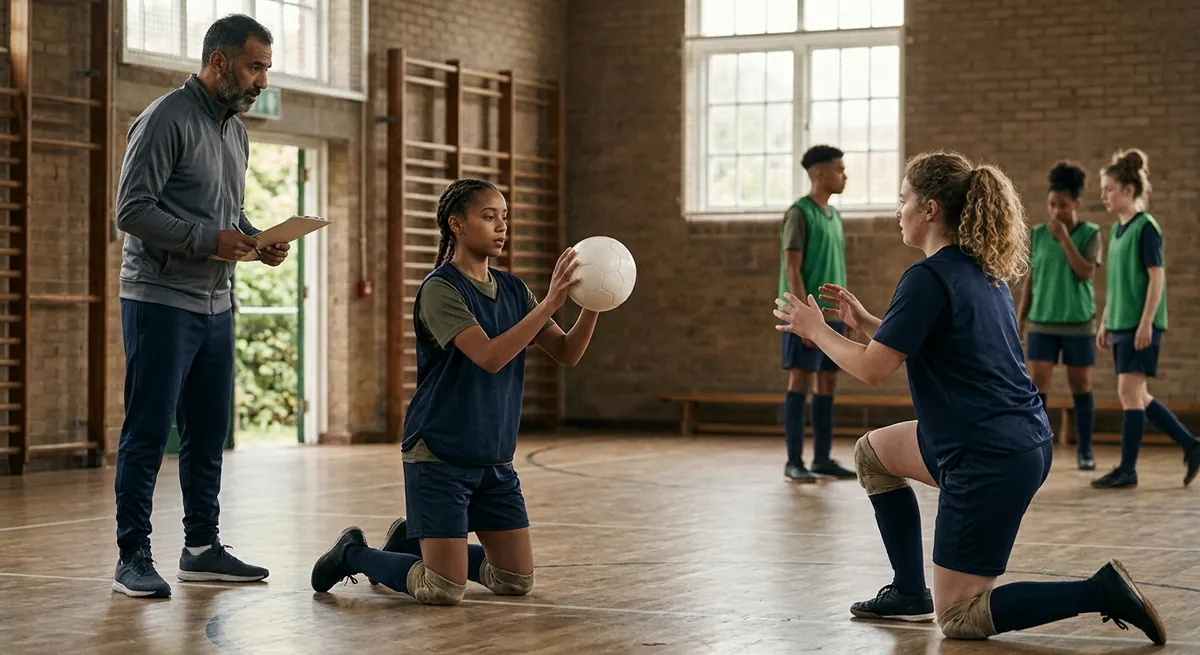
- Seated w. Serve underarm to the chest. Catch with thumbs together behind the ball in a W, pulling it in. Ten.
- Seated scoop. Serve low to the lap. Little fingers together, scoop and cradle. Ten.
- Kneeling. Up onto the knees. Ten W catches to the chest, ten scoops to the ground either side.
- Crouch. Into a low set position, weight forward. Ten catches each side, moving the feet before the hands.
- Count it. Sixty seconds of mixed serves. Count clean catches with no fumble. Write it down.
Coaching points
- Thumbs together behind the ball for a chest catch; little fingers together for a low one
- Hands first, then the body behind the ball as a second barrier
- Elbows in and soft; stiff arms bounce the ball out
What to watch: Catching with the arms rather than the hands, and the elbows wide. Hands first, body behind the ball second.
Common mistakes
- Catching with the arms and chest rather than the hands
- Elbows wide and stiff, which bounce the ball out
- Thumbs apart on a chest catch so the ball goes through the hands
- Reaching with the hands before the feet have moved in the crouch
- Looking at the server instead of the ball all the way into the hands
What good looks like
A good target: 20 clean catches in 60 seconds with the W or the scoop and no fumble.
Progressions and variations
Making it harder
- Level 1: Seated catches only, soft and slow
- Level 2: The scoop added, and the serves a little quicker
- Level 3: Kneeling, with serves to either side
- Level 4: The crouch, with the feet moving first
- Level 5: Serves called 'chest' or 'low' only as the ball leaves the hand
- Level 6: Thirty clean catches in a minute from mixed serves
Alone, with a sibling, or in a group
- Solo: kneeling three steps from a wall, throwing softly and catching the return.
- Sibling: one serves underarm and counts clean catches, swapping after each set.
- Co-op: pairs in a line of keepers, one leader calling 'chest', 'low', 'left', 'right'.
Adjusting it by age
- U14: Soft underarm serves, seated and kneeling only, with the W and the scoop shown slowly before any count. Catching is a game before it is a drill.
- U18: Firmer serves, the crouch, and calls as the ball leaves the hand, then follow with the GK footwork drill so the set position carries into a shuffle.
For the parent running it
- Serve underarm from three steps, low and soft to start, and watch the hands. Thumbs together behind the ball for anything chest height, little fingers together for anything low.
On their own: Kneel three steps from a wall, throw the ball softly against it and catch the return. Count clean catches in a minute.
Safety
- Underarm serves only indoors, and nothing breakable behind the keeper
- A mat under the knees for the kneeling set on a hard floor
More on training safely at home: Safety at Home.
Related drills
GK Handling
Basic shot-stopping: set position, W-grip, collapse dive.
Catch and Throw in Four
Catch a ball and throw it out to a teammate breaking wide inside four seconds: the futsal goalkeeper's job of turning a save into a counter-attack before the other team can recover.
GK Footwork: Shuffle and Set
Side-step across a goal-width line of cones, stop in a set position, and catch a dropped ball cleanly before shuffling on.
GK Distribution: Roll and Throw
A keeper starts the attack with the hands: bowl the ball along the ground through a near gate, then throw overarm into a far target zone.
Run it with the Audio Coach
In Spatrian the Audio Coach talks your player through this drill while they play it, and each run goes on their own training record, which their coach or personal trainer can read and, for a homeschool family, counts as PE time. The beta is opening to a small first group of players and families.